




Pragmatic | Practical | Good
ISO 27001
From CAP analysis to certification—
—we guide you through the entire process.
Are you looking for experts with many years of experience in the implementation, auditing, and practical application of ISO 27001 certification?
ISO 27001 Explained Simply

Are you looking for a comprehensive solution for implementing ISO 27001?
Your All-in-One Solution
With our expertise in implementing ISO 27001, you’ll receive customized tools for a sustainable security strategy. We’ll guide you from the initial risk analysis through successful certification and beyond.
Rely on certified security as the foundation for your business success.
Your benefits at a glance:
- Protection of sensitive company data
- Strengthening your market position through verifiable security standards
- Sustainable risk minimization through compliance
ISO 27001 Reference Projects
Industry:
Small and Medium-Sized Enterprises
Position:
Project Manager
Areas of Responsibility:
- Implementation of an IT security concept (IT audit, IT compliance, and IT risk management with the goal of achieving DIN ISO 27001 certification and MA-RISK compatibility)
- Gap analysis (ISO 27001, MA-RISK, compliance, and data protection)
- Establishment of an ISMS—policies & documents
- Conducting interim audits to prepare for ISO 27001 recertification
- Processes and ICS
- Project or Action Plan (Scope)
- Preparation of Documentation & Guidelines
- Implementation of ICS & Processes
- Support with client questionnaires and audits
- ISMS audit preparation (DIN ISO 27001)
- Support for audit execution (DIN ISO 27001)
- Development of IT security concepts (data deletion policies, etc.)
Industry:
IT Service Provider
Position:
Project Manager
Areas of Responsibility:
- Review of measures outlined in the ISO 27001:2022 standard to prepare for audits and review of documentation
- Evaluation of the measures implemented and outstanding issues
- Preparation of a final report
- GAP analysis
- Classifications and specific considerations for affiliated companies
- Guidelines and documents
- Processes and ICS
- Action Plans
Industry:
Small and Medium-Sized Enterprises
Position:
, Project Manager
Areas of Responsibility:
- IT security maturity analysis and benchmarking
- Identification of high-level cybersecurity gaps to improve cybersecurity, including prioritization and a rough estimate of effort (low, medium, high)
- Presentation of the cybersecurity maturity level results
- Development of a roadmap for addressing the identified gaps
- Based on the maturity analysis, work began immediately on addressing the identified issues, incorporating insights from past experience
- Development of an ISMS (Information Security Management System)
- Development of policies and documents
- Definition of processes and an internal control system (ICS)
- Support in the implementation of the policies and the ICS
- Development and coordination of a project and action plan for the ISMS
- Support for an internal ISO 27001 audit
- Support with ISO 27001 certification
Industry:
Healthcare
Position:
CISO
Areas of Responsibility:
- Establishment of an integrated management system
- Document control using Confluence
- Process controls using Jira (change management for MDR products)
- Policy training (company-wide)
- Establishment of risk management
Industry:
Small and Medium-Sized Enterprises
Position:
Information Security Officer (ISB / ISO)
Areas of Responsibility:
- Internal coordinator for the implementation of an ISMS in accordance with ISO 27001 and ensuring compliance with the standard
- Internal Information Security Officer (ISB/ISO) responsible for the operational implementation of security measures and processes
- IT-related implementation of ISMS requirements, including access controls, logging, monitoring, and network security
- Conducting a gap analysis to identify discrepancies between the current state and the standard requirements, supported by a consulting firm using the VDA ISA 5.1 catalog
- Development and implementation of security policies and processes, e.g., malware protection, network security, access control, cryptography, supplier management, cloud services, business continuity management (BCM), risk management, Clean Desk & Clear Screen, change control, logging, information classification, and identity and access management (IAM)
- Leveraging synergies with other existing management systems
- Conducting and managing risk assessments and mitigation measures
- Conducting management reviews
- Planning and conducting internal audits, identifying opportunities for improvement, and overseeing corrective actions
- Development and implementation of emergency plans (BCM) and recovery strategies, and management of emergency drills
- Assessment and management of security-critical changes to IT systems and processes
- Development of an audit program
- Conducting technical audits to review IT security measures, identify vulnerabilities, and derive improvement measures
- Training and raising employee awareness of the guidelines
Industry:
Small and Medium-Sized Businesses / Infrastructure
Role:
Information Security Officer
Areas of Responsibility:
- Defining Objectives and Clarifying Expectations for the ISMS:
Clarifying the objectives and expectations of the Information Security Management System (ISMS) in accordance with company requirements. - Risk Analysis:
Conducting a risk analysis to identify potential security risks; identifying core resources and critical business processes; analyzing existing security measures and their effectiveness; categorizing risks based on potential damage and probability of occurrence. - Process Development:
Defining processes for risk control and treatment; establishing procedures for the regular review and updating of the ISMS. - Policy Development:
Development of an overarching information security policy to serve as documented management commitment to information security; development of a policy describing the ISMS processes related to risk management; development of policies for end users, data classification, access control, and physical security. - Consulting on the assignment of responsibilities:
Support in defining roles and responsibilities within the ISMS; support in selecting the Information Security Officer. - Development of IT security concepts:
Development of authorization concepts; development of logging concepts.
Industry:
Small and Medium-Sized Businesses / Software Development)
Position:
Information Security Officer
Areas of Responsibility:
- Implementation of an IT security strategy (IT audit, IT compliance, and IT risk management) with the goal of achieving ISO 27001 certification and MARISK compatibility
- Gap analysis (ISO 27001, MARISK, compliance, and data protection)
- Policies & Documents
- Processes and ICS
- Project or Action Plan (Scope)
- Preparation of documentation & guidelines
- Implementation of ICS & Processes
- Support with Customer Questionnaires and Audits
- Audit preparation (ISO 27001)
- Development of Concepts in Accordance with ISO 27001 (e.g., Authorization and Logging Concepts)
- Support for conducting audits (ISO 27001)
Industry:
SMEs / Infrastructure
Role:
Information Security Management Consultant
Areas of Responsibility:
- Maturity analysis and criticality assessment of processes
- Recommendations for controls and processes (quick wins, short-, mid-, and long-term)
- Development of emergency guidelines and playbooks based on the ISO 27001 standard
Industry:
Small and Medium-Sized Enterprises
Position:
Project Associate
Areas of Responsibility:
- Support for the implementation of an IT security concept (IT audit, IT compliance, and IT risk management with the goal of achieving DIN ISO 27001 certification and MA-RISK compatibility)
- Gap analysis (ISO 27001, compliance, and data protection)
- Support in conducting interim audits to prepare for ISO 27001 recertification
- Project or action plan (scope)
- Preparation of documentation and guidelines
- Implementation of ICS & processes
- Support with client questionnaires and audits
- Support for ISMS audit preparation (DIN ISO 27001)
- Support for conducting audits (DIN ISO 27001)
Industry:
Banking / Finance
Position:
Project Associate
Responsibilities:
- Supporting the Information Security Officer in day-to-day operations; developing, implementing, monitoring, and updating the information security policy
- Developing and maintaining security policies and processes, guidelines, and recommendations, as well as conducting internal control system (ICS) audits of information security
- Informing and advising the organization on matters related to information security, including regular and ad hoc reporting
- Supporting IT projects and procurement processes with regard to information security
- Assisting with the oversight of IT service providers
- Planning and conducting security reviews and IT security audits
- Managing the assessment of current threats and vulnerabilities
- Participating in the analysis of security-related incidents
- Assessing security incidents and managing resulting corrective actions
ISO 27001: Your Commitment to the Highest Level of Information Security
What is ISO 27001?
ISO/IEC 27001 is an internationally recognized standard for information security management systems (ISMS). It provides organizations of all sizes with a reliable foundation for systematically managing information security, consciously identifying risks, and proactively minimizing vulnerabilities. ISO/IEC 27001 certification is a crucial mark of quality, particularly for organizations that must protect sensitive data—such as operators of critical infrastructure (KRITIS). It not only confirms compliance with legal requirements but also strengthens the trust of customers and partners. Thanks to the so-called “High Level Structure,” the standard can also be easily combined with other standards such as ISO 9001 (quality management).


Protect what matters:
Why ISO 27001 Is Relevant to Your Business
In light of rising cybercrime and complex threats, companies face the challenge of effectively managing their cyber risks.
The EU’s NIS2 Directive further underscores the importance of ISO/IEC 27001 certification. By October 2024, up to 40,000 companies in Germany are expected to be required to implement an ISMS.
An ISMS in accordance with ISO 27001 entails:
- Technical, organizational, and personnel security measures
- Integration of security policies into business processes
- Sustainable risk management for greater cyber resilience
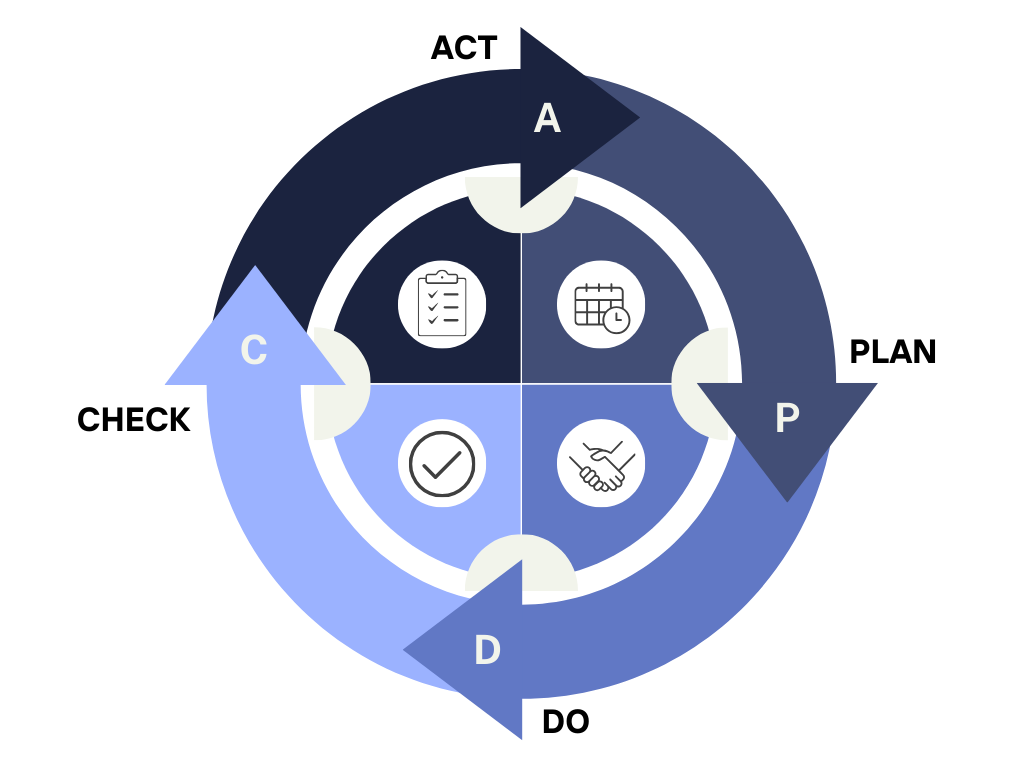
PDCA Cycle
SAFETY IS NOT A ONE-TIME MEASURE—IT IS AN ONGOING PROCESS
The ISO
Certification Process
Step by step toward ISO 27001 certification.
The PDCA cycle (“Plan-Do-Check-Act”) supports continuous improvement and enables flexible adaptation to new threats and changing requirements.

Define the Scope:
We begin by defining the scope of your ISMS. This involves defining and documenting the information security objectives and aligning them with your business requirements.
Clarify Responsibilities:
Roles and responsibilities are assigned, an asset register is created, and an information security policy is developed to serve as the framework for all measures.
Establishing Commitment:
Using specially developed guidelines and awareness-raising measures, we raise your team’s awareness and lay the foundation for a shared understanding. This also includes training sessions tailored specifically to your organization.
Implementing Measures:
The defined security measures and policies are integrated into daily operations. In addition, we support you in conducting training sessions and establishing awareness campaigns to promote security awareness.
Apply risk management:
Together, we identify business-critical assets, analyze potential risks, and develop appropriate risk mitigation measures. This allows you to minimize risks effectively and in a targeted manner.

Conduct a GAP Analysis:
In a detailed GAP analysis, we compare the current state of your ISMS with its target state. The goal is to identify gaps and derive improvement measures.
Prepare and conduct an internal audit:
An internal audit assesses the effectiveness of your ISMS policies and ensures that set goals are being met.
Measuring KPIs:
Using defined Key Performance Indicators (KPIs), we verify whether the measures are effective and whether the security level is being maintained.

Management Review:
The results of the audit and KPIs are analyzed during a management review. Based on this analysis, we identify actions aimed at improving your ISMS.
Continuous Improvement:
Your ISMS remains dynamic: Based on new insights, current risks, or changes in the regulatory environment, we adapt processes and measures. This ensures long-term protection and sustainable security management.
ISO 27001 CERTIFICATION AND AUDITS
ISO 27001 certification attests that your company has successfully implemented an ISMS in accordance with international security standards. This certification is conducted by independent, accredited auditors who review and confirm the effectiveness of the security measures put in place.
Your benefits:
- Official proof of high security standards
- Strengthened trust among customers and partners
- Sustainable security management
Focus on Your Security Strategy
ISO/IEC 27001 provides you with a structured guide to take your information security to the next level and continuously improve it.
Would you like to tailor your information security to your company’s specific needs?
Let’s discuss how we can successfully implement your security strategy.
Schedule a no-obligation consultation now—we look forward to hearing from you!

FAQs
The clear answer is: No.
ISO/IEC 27001 certification is not mandatory, but it may be a legal or regulatory requirement in certain cases. It provides organizations with a structured and internationally recognized framework for establishing, continuously improving, and verifiably documenting their information security at the highest level.
ISO/IEC 27001 plays a particularly important role in the context of Section 8a(3) of the German Federal Information Security Act (BSIG). It can be a central component of the required evidence, as it enables security measures to be designed in a systematic and traceable manner. This is particularly important for operators of critical infrastructure (KRITIS), who must demonstrate the protection of their services and facilities to ensure the security of supply for the population.
Organizations for which ISO/IEC 27001 certification is particularly relevant:
- Critical Infrastructure (KRITIS): Companies and organizations operating in sectors such as energy supply, healthcare, information technology, transportation, or water management are often subject to strict legal requirements, such as those under Section 8a of the German Federal Security Act (BSIG). ISO/IEC 27001 certification—including certification based on IT-Grundschutz—can be used as part of the evidence of appropriate security measures. It helps ensure the availability, integrity, confidentiality, and authenticity of critical services.
- Financial service providers and banks:
Due to the sensitive nature of financial data and strict regulations, ISO/IEC 27001 certification serves as important evidence for customers and regulatory authorities. It protects against security incidents and ensures compliance with industry-specific standards. - IT and technology companies: Providers of cloud services, Software-as-a-Service (SaaS), hosting, or managed services benefit greatly from ISO/IEC 27001 certification. It demonstrates to customers and partners that sensitive data is handled reliably and strengthens trust in their security processes.
- Healthcare and medical organizations:
Clinics, hospitals, and pharmaceutical companies process highly sensitive patient data. The certification helps close security gaps and ensure the confidentiality and availability of medical information. - Public Institutions and Government Agencies:
To protect citizen data and government-related information, government agencies are increasingly relying on a certified ISMS. This fosters transparency and trust. - Companies with high customer expectations:
Many customers demand a high standard of security from their business partners. Companies that process sensitive data on behalf of third parties can gain a decisive competitive advantage through ISO/IEC 27001 certification.
- Enhanced Information Security:
Implementing an Information Security Management System (ISMS) protects your sensitive data and IT infrastructure from current and future threats. Security vulnerabilities are identified early on, and appropriate measures ensure robust defense against cyberattacks. - Compliance with Legal Requirements:
ISO/IEC 27001 helps companies comply with all relevant legal and regulatory requirements in the areas of data protection and information security. - Efficient risk management:
A robust and up-to-date ISMS (Information Security Management System) identifies potential vulnerabilities early on and provides effective measures for risk mitigation. This ensures a high level of security and resilience against cyberattacks. - Cost Savings:
By minimizing security incidents and optimizing internal processes, companies reduce both direct IT security costs and the costly consequences of security incidents. - Integration into existing management systems:
Thanks to its compatible Annex SL structure, ISO/IEC 27001 can be seamlessly integrated into existing systems such as ISO 9001 (quality management). This reduces the effort required for audits, updates, and reviews and creates synergies. - Continuous improvement:
Internal audits and regular reviews make it possible to identify vulnerabilities and implement targeted improvements. This ensures your ISMS remains up to date and can respond flexibly to new threats. - Building Trust:
Certification signals to customers, partners, and stakeholders that your company meets the highest standards in data security. This builds trust in your organization and can open up new business opportunities. - Competitive Advantage:
Certification underscores your commitment to information security and
positions your company as a trustworthy partner. This sets you apart from the competition while minimizing legal and financial risks. - Promoting a Culture of Security:
The standard promotes a holistic approach to security awareness that is embedded throughout the entire organization. Employees are made aware of the importance of secure IT system usage through clear behavioral guidelines and training. - Long-term resilience:
ISO/IEC 27001 strengthens your company’s resilience against business disruptions and ensures that you can respond flexibly to new challenges.
- Implementation and Setup of an ISMS:
To obtain ISO 27001 certification, your company must implement an ISMS. This system ensures the continuous review and improvement of security policies, user access controls, and processes. It serves as the foundation for the proactive identification and management of information security risks. - Classification of Corporate Assets:
A key requirement is the classification of your corporate assets. This involves conducting a comprehensive inventory of relevant assets to assess their protection needs. Only in this way can your ISMS be tailored to the specific risks and requirements. - Conducting a Risk Analysis:
Another key component of
is the risk analysis. This helps identify potential security risks
and define appropriate measures. The risk assessment forms the basis for selecting and implementing the right security controls. - Defining the ISMS Context:
ISO 27001 requires organizations to define their organizational context, including the expectations and requirements of relevant stakeholders regarding information security. It is necessary to determine the scope of the ISMS and clearly define which systems, departments, and data are included in security management. - Commitment from top management:
Top management must commit to information security and establish a security strategy. It is responsible for providing resources, assigning responsibilities, and fostering a culture of continuous improvement. Only with management’s support can the ISMS be effectively implemented and maintained. - Planning and Goal Setting:
As part of the planning process, your organization must establish information security objectives that are consistent with the security strategy and the risk assessment. These objectives should be measurable and linked to clearly defined actions for achieving them. This also includes assigning responsibilities and setting timeframes. - Support and Resources:
A successful ISMS requires the allocation of resources and the promotion of security awareness throughout the organization. All employees must be trained in information security and continuously made aware of its importance. Clear communication and documentation are also necessary to ensure consistent implementation of security policies. - Operations and Risk Management:
Your organization must take operational
measures to manage security risks. This includes implementing security controls as well as continuously monitoring and adapting these measures to address evolving threats and risks. Regular monitoring and risk assessment are essential. - Performance Evaluation and Internal Audits:
The performance of the ISMS must be regularly monitored and evaluated. This includes internal audits and management reviews to ensure that all security measures are effective and that the established objectives are being met. The results of these reviews should be documented and used as a basis for improvement measures. - Continuous Improvement:
ISO 27001 requires organizations to continuously work on improving their ISMS. If nonconformities are identified during audits, organizations must analyze them
and take appropriate corrective actions. Continuous improvement is crucial for adapting the ISMS to evolving threats and
technological changes and for ensuring that information security is maintained over the long term. - Security controls according to Annex A:
ISO 27001 includes a list of 114 security controls in 14 categories in Annex A, which organizations can implement based on their specific risk assessment. However, it is not necessary to adopt all of these controls—only those that are relevant to your organization’s individual security requirements.
Costs:
Costs depend on various factors, including the size of your company, the complexity of your IT systems, and the scope of the planned ISMS. The main costs can be broken down into the following categories:
- Consulting costs: External experts
assist you with the planning and implementation of the ISMS. - Training costs: Training for your employees to help them understand and implement security-related best practices.
- Implementation costs: Investments in the implementation of security measures and technologies.
- Certification costs: Fees for the certification audit and the issuance of the certificate by the accredited certification body.
- Maintenance costs: Ongoing costs for audits, reviews, and adjustments to the ISMS to ensure continued compliance with requirements.
Duration:
The time required for implementation and certification varies depending on your organization’s starting point and complexity.
Typical phases and timeframes are:
- Phase 1: Planning and Implementation of the ISMS
In this phase, a risk assessment is conducted, security policies are developed, and initial steps are taken to implement security measures.
Duration: 3 to 6 months, depending on resources and the initial situation - Phase 2: Internal Audit and Management Review
After implementation, the ISMS is reviewed internally and approved by senior management.
Duration: 1 to 2 months - Phase 3: Certification Audit
The audit takes place in two stages:
Stage 1: Review of the ISMS documentation
Stage 2: On-site review of the implementation and effectiveness of the ISMS.
The certification audit typically lasts a few days per stage, with breaks ranging from several weeks to one month in between.
Duration: 1 to 2 months in total - Overall timeframe:
The entire process takes an average of 6 to 12 months; however, for larger or more complex organizations, it can take up to 18 months.
Validity:
An ISO 27001 certification is valid for three years. During this period, annual surveillance audits are conducted to ensure that the ISMS continues to meet the requirements. After three years, recertification is required to extend the validity of the certification.