




easy to understand | practical | affordable
Cyber Risk Assessment
The CyberRiskCheck was developed specifically for small and medium-sized enterprises (SMEs) to identify and effectively minimize IT security vulnerabilities in a practical, understandable, and efficient way—without complicated processes or significant investment.
Take the first step toward greater security.
Cyber Risk Assessment: Explained Simply

IT Security Consulting Specifically for SMEs
What is the Cyber Risk Check?
The CyberRiskCheck, based on DIN SPEC 27076, is a standardized procedure for assessing IT security, specifically designed for small and medium-sized enterprises (SMEs) with up to 50 employees. The CyberRiskCheck was developed in collaboration with the Federal Office for Information Security (BSI).
The CyberRiskCheck focuses on security aspects relevant to SMEs and is based on the essential requirements of the BSI’s Basic Protection Catalog (IT-Grundschutz) to enable the rapid and effective implementation of IT security measures. The result is a detailed analysis of existing vulnerabilities, as well as clear, prioritized recommendations for action that companies can put into practice immediately.
From a Cyber Risk Assessment to ISO 27001 Certification
The Cyber Risk Assessment in Detail
DIN SPEC 27076 can serve as a practical first step toward ISO 27001 certification and helps small and medium-sized enterprises (SMEs) implement basic IT security measures in a structured manner. Through the CyberRiskCheck, companies receive an initial assessment of their current IT security status and clear recommendations for improvement. This creates a solid foundation upon which further security concepts can be built and preparations for meeting the requirements of ISO 27001 can be made step by step.
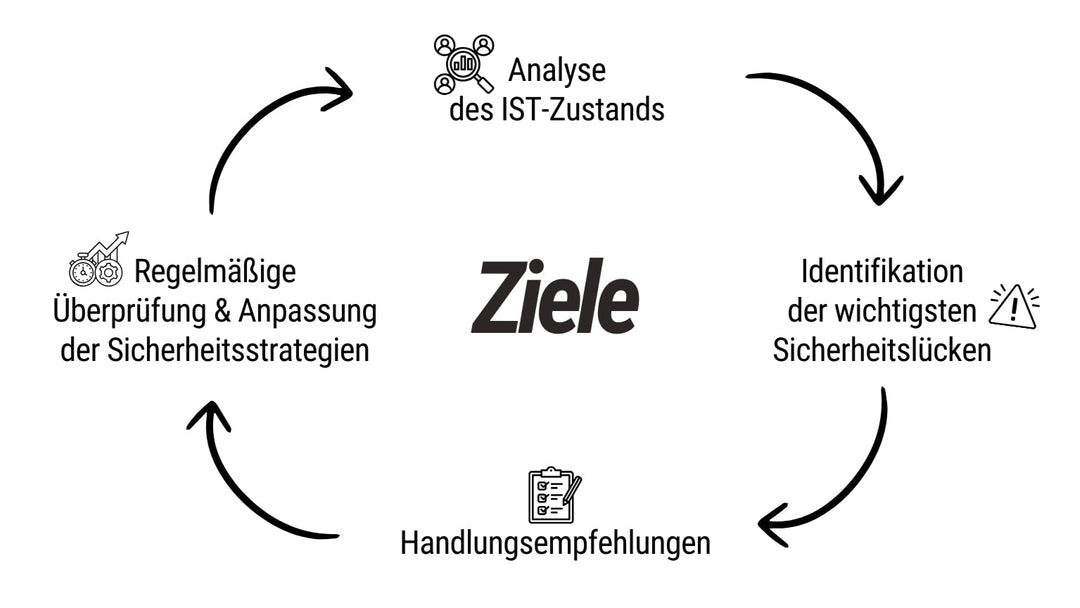
Conducting the Cyber Risk Assessment

The process begins with an introductory meeting, during which the entire CyberRiskCheck process and the list of requirements are explained in detail, and any questions are answered.
In an interview or questionnaire (usually lasting one to two hours), an experienced IT service provider asks the company about its current IT security situation.
The CyberRiskCheck requirements catalog covers six key areas that are critical to the security assessment:
- Organization & Awareness
- Identity and Access Management
- Data Backup
- Patch and Change Management
- Protection Against Malware
- IT Systems and Networks
The catalog contains a total of 27 requirements and 54 specific questions that help determine the current security status.

Answers are scored according to the guidelines of DIN SPEC 27076. The maximum number of points that can be earned is 37.
These points indicate how well the company is positioned in the various areas of IT security and where potential vulnerabilities exist.
After the assessment, the company receives a detailed report that outlines both the current state of its IT security and clear recommendations for action.
The recommendations are ranked by urgency and relevance to provide the company with a practical and clearly structured plan for improving its IT security. In addition, the report includes information on government funding opportunities that the company can take advantage of to implement the recommended measures (e.g., funding programs at the federal, state, or local level).
Your Path to a Secure IT Strategy
The CyberRiskCheck in accordance with DIN SPEC 27076 provides a structured analysis of your IT security posture; however, it does not replace individual consulting or comprehensive security measures. It identifies vulnerabilities and provides targeted recommendations for action—for long-term security, we recommend pursuing ISO 27001 certification.
Would you like to improve your IT security in a targeted way?
Contact us—together, we’ll develop the right strategy for your company.
Schedule a no-obligation appointment now—we look forward to hearing from you!
FAQs
The clear answer is: Yes.
It is recommended that you repeat the CyberRiskCheck at regular intervals. IT security risks are constantly evolving—just like your business. Growth, new technologies, or structural changes can all impact your security posture. By conducting another assessment, you ensure that your security measures are always up to date and adapted to new challenges.
This will help you remain secure and resilient against cyberattacks in the long term.
- Practical IT Security Assessment:
Thanks to a clearly defined checklist, you’ll receive a well-founded assessment of your current IT security situation. The CyberRisikoCheck is based on proven BSI standards and provides you with a structured analysis—presented in an easy-to-understand format and without unnecessary complexity. - Customized recommendations for sustainable security:
You’ll receive not only an overview of potential vulnerabilities but also concrete, prioritized measures to optimize your IT security. The recommendations are specifically tailored to the needs and resources of small and medium-sized businesses (SMEs), so you can begin implementation right away. - Fast and resource-efficient implementation:
The CyberRiskCheck offers an efficient alternative to time-consuming IT audits. Within a short time, you’ll gain valuable insights into your security posture without tying up internal resources long-term. - Strengthening resilience against cyberattacks:
By regularly reviewing your IT security measures, you increase your company’s resilience against digital threats and ensure sustainable protection.
The CyberRisikoCheck helps you identify risks early on and take timely countermeasures. - Greater compliance and trust among customers and business partners:
A strong IT security strategy signals professionalism and reliability. Participating in the CyberRiskCheck shows your customers and partners that you take IT security seriously—a decisive competitive advantage in the digital business world. - Transparency regarding investments and funding opportunities:
Optimizing IT security doesn’t have to be expensive: The CyberRisikoCheck not only provides clarity on necessary measures but also highlights which government funding programs are available to help reduce your investment costs.
The CyberRiskCheck in accordance with DIN SPEC 27076 provides a thorough analysis of your current IT security situation and identifies existing vulnerabilities. However, it does not replace a comprehensive security strategy or further measures to address the identified risks.
The following are not included in the scope of services:
- Technical implementation of security measures:
Vulnerabilities are identified as part of the CyberRiskCheck, but the actual implementation is the responsibility of your company. Upon request, we’d be happy to assist you with implementation. - Continuous security monitoring:
The CyberRiskCheck provides a snapshot of your IT security and does not replace continuous monitoring or comprehensive security monitoring. - Guaranteed protection against cyberattacks:
Compliance with the DIN SPEC 27076 requirements provides a solid foundation for your IT security. However, no procedure can guarantee complete protection against cyber threats. - ISO 27001 Certification: The CyberRiskCheck serves as a valuable guide and starting point for a structured IT security strategy, but it does not replace official certification. We would be happy to advise you on additional measures to achieve an even higher level of protection.
There are various funding opportunities that can help your company improve its IT security. Programs are available at both the federal and state levels that provide financial relief specifically to SMEs for implementing security measures.
- Federal Program “Funding for Management Consulting Services for SMEs”: This program covers up to 80 percent of the costs of consulting services, up to a maximum of 2,800 euros. This allows you to receive professional support in analyzing and optimizing your IT security strategy.
- “NRW – MID Digital Security” Initiative: Designed specifically for companies in North Rhine-Westphalia, this program offers support for improving digital security. Funding is available for training sessions and workshops, among other things. You can apply for between 4,000 and 15,000 euros in funding over a 12-month period.
- Regional Funding Programs: In addition to federal initiatives, there are also regional programs that provide targeted support to companies seeking to improve their IT security. The amount of funding and the exact eligibility requirements vary by state.
Would you like to learn more about the CyberRiskCheck?
For more information, please visit the BSI's official website and refer to DIN SPEC 27076:2023-05.