




Competent | Efficient | Pragmatic
External Data Protection Officer
Data protection at the highest level—we ensure your compliance, minimize risks, and strengthen the trust of your business partners.
Are you looking for experienced experts who can implement complex data protection requirements efficiently and in a practical manner?


Data Protection Check for Businesses
When is a data protection officer required?
Under the General Data Protection Regulation (GDPR) and the Federal Data Protection Act (BDSG), a company is required to appoint a data protection officer if certain conditions are met.
Take the data protection check for your company.
Quick and easy:
Our External DSB Packages
Bronze
- Benennung externer DSB
- Onlineschulung
- Nennung bei Behörde
- Nennung auf Website
- Vorlagen & Checklisten
BEST VALUE
Silber
- 10 Beratungsstunden / Jahr
- Webseiten & Social Media Check (jährlich)
- Statusbericht (jährlich)
- Verarbeitungsverzeichnis
- Erstes Datenschutzaudit
- Datenschutzerklärungen für Websiten
Inklusive aller Bronze Vorteile
Jetzt anfragenGold
- 20 Beratungsstunden / Jahr
- Jährliches Datenschutzaudit
- Folgenabschätzung & Technikberatung
- Addons: Phishing, Schwachstellenscans, Pentests
Inklusive aller Bronze und Silber Vorteile
Jetzt anfragenPlatin
- DSMS & Vertragsprüfungen
- Risikomanagement
- Technische Beratung
- Behördenkommunikation
- Awareness-Kampagnen
Inklusive aller Bronze, Silber und Gold Vorteile
Jetzt anfragenYour Expert in Data Protection & Compliance
What is a data protection officer?
An external Data Protection Officer (DPO) is an independent expert who assists companies and organizations in implementing the requirements of the General Data Protection Regulation (GDPR) and other data protection laws in a legally compliant manner. The DPO is not part of the workforce but brings extensive expertise from various industries to the role.
By engaging an external Data Protection Officer, companies benefit from immediate availability, impartial advice, a high level of specialization, and clearly predictable costs—without tying up internal resources.

Strategic Consulting & Operational Implementation—All Under One Roof
What does a data protection officer do?
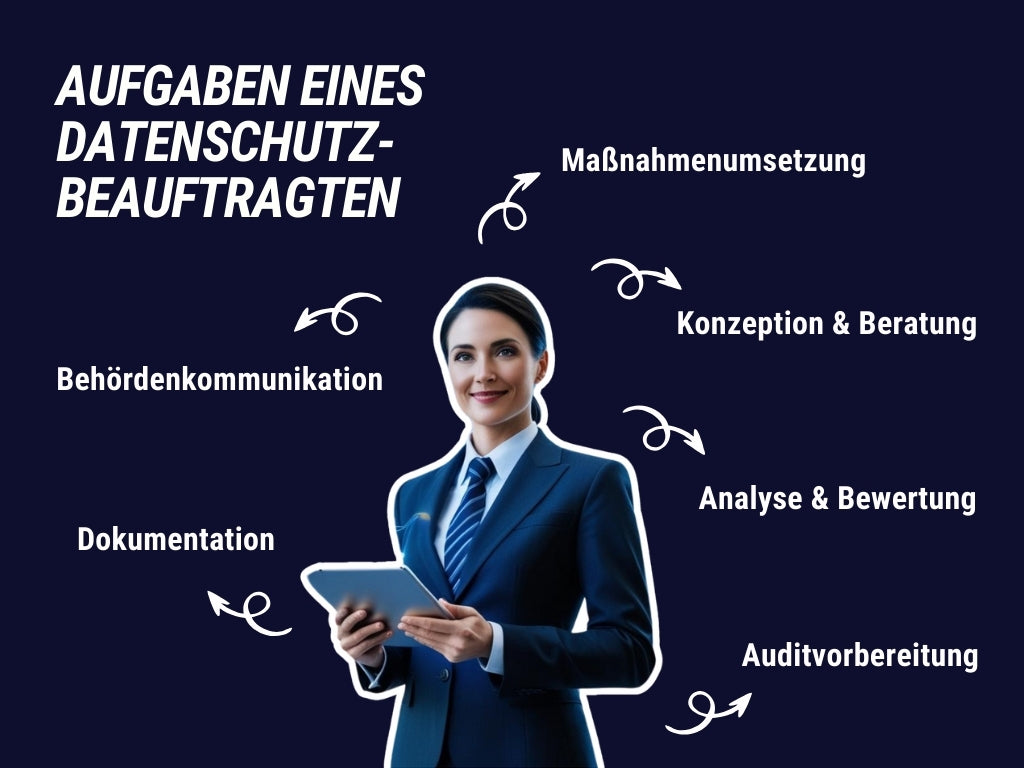
The external data protection officer assumes operational and strategic responsibility for ensuring compliance with data protection requirements within the company. He analyzes existing processes, identifies data protection risks, and develops targeted measures to minimize risks and ensure compliance with the GDPR and the BDSG (Federal Data Protection Act). In doing so, he works closely with management and relevant departments to ensure that data protection requirements are implemented efficiently and in compliance with the law.
Typical areas of responsibility include:
- Development and refinement of data protection-compliant processes and structures
- Advising on the implementation of technical and organizational measures (TOM)
- Conducting and evaluating data protection impact assessments (DPIA)
- Serving as the point of contact for senior management, functional departments, and regulatory authorities
- Training and raising awareness among employees
- Support during audits and internal review processes
In-House vs. External Data Protection Officer
Focus on Your Data Protection Strategy
By engaging an external data protection officer, you gain immediate access to expert knowledge, reduce liability risks, and project a professional image to the outside world.
Our experts review your processes, identify vulnerabilities, and ensure long-term compliance with the GDPR and the BDSG.
Schedule a no-obligation consultation today—we look forward to hearing from you.

FAQs
When selecting an external Data Protection Officer (DPO), companies should place particular emphasis on professional competence, experience, and trustworthiness. A qualified external DPO should not only have certified knowledge in accordance with Articles 37–39 of the GDPR, but also possess practical experience across various industries. Equally important is the ability to communicate complex data protection requirements in an understandable way and translate them into practical measures.
Here’s a summary of the key points for you:
- Certifications & Continuing Education:
Verifiable qualifications in data protection law, IT security, and compliance. - Industry Knowledge:
Ideally, experience with companies of a similar size and structure to yours. - Contractual Transparency:
Clear provisions regarding services, availability, liability, and cost structure. - Communication Skills:
The data protection officer should serve as a trusted point of contact for both management and employees. - Interdisciplinary skills:
An understanding of technical workflows, IT infrastructures, and organizational processes is essential.
The General Data Protection Regulation (GDPR) does not prescribe fixed intervals for data protection reviews or audits. However, effective data protection management is not a one-time project, but rather an ongoing process. As a general rule, internal data protection measures should be systematically reviewed at least once a year—especially in the event of changes to the IT infrastructure, new processing activities, or legal amendments.
In addition, we recommend regular internal audits or external reviews on a fixed schedule (e.g., every 12 to 18 months) to identify risks early and take proactive measures to mitigate them. For security-critical industries, highly interconnected systems, or large volumes of data, a semi-annual review may also be advisable.
The key point is this: Data protection must grow alongside the company—technically, organizationally, and legally.
In principle, the company, as the data controller, is responsible for compliance with the General Data Protection Regulation (GDPR).
A data protection officer (whether internal or external) provides advice and oversight but is not itself responsible within the meaning of the GDPR. Nevertheless, if an internal data protection officer breaches their duties through gross negligence or intentionally, liability under labor law may apply.
In the case of an external data protection officer, the liability risk can generally be clearly defined in the contract. In practice, civil liability often applies here, which makes the legal situation significantly more predictable for companies.
The cost of an external data protection officer depends on individual needs and the size of the company. In most cases, the fee is based on a monthly flat rate. This typically covers all agreed-upon services, such as:
- Initial assessment and risk analysis
- Creation and maintenance of the record of processing activities
- Advice on data protection measures
- Employee training
- Communication with supervisory authorities
- Regular reviews and audits
Advantage: Costs are transparent, predictable, and scalable, as they are specified in the contract.